


















What Is Herringbone Fabric? The Weave, the Myths and How to Spot the Real Thing
You know the pattern the moment you see it. That tidy run of little Vs marching across a coat, a sofa, a throw. Almost everyone can point at it, and almost nobody can say what herringbone fabric actually is. The honest answer is that it is not a fabric at all.
Herringbone is a broken twill weave. The diagonal rib of a twill reverses direction at regular intervals, and at each reversal the columns step sideways rather than meeting, producing a broken zigzag that resembles the skeleton of a herring. It is a structure, not a fibre.
That one distinction settles most of what people arrive wanting to know. Below we cover how the weave is actually made, the chevron mix-up nearly everyone repeats, why herringbone wears and warms the way it does, and a ten-second test that separates woven herringbone from printed.

Herringbone Is a Weave, Not a Fabric
The word doing all the work in "broken twill weave" is "broken", and hardly anyone explains it.
Start with the twill, a cloth with a diagonal rib of the sort you see on denim or tweed. Each pass of the weft steps one thread along from the last, so the crossing points line up on a slant.
Herringbone reverses that diagonal at regular intervals, typically every four to twelve passes of the weft. A short reversal gives a fine, tight fishbone; a long one, a broad zigzag you could read across a room.
Now the part most explanations skip. At each reversal the columns shift sideways by one or more warp threads, so the two diagonals never converge into a continuous peak. They stop, step across, and set off the other way. That step is the break.
The classic structure is a 2:2 twill, two threads over and two under, and the earliest dated herringbone fabric we have is woven in exactly that. Wool leggings from the Alps date to 800-500 BC; a woven horsehair herringbone came out of a Northern Irish peat bog at 750-600 BC. More sit among the Hallstatt salt mine textiles.
Two familiar origin stories belong to other crafts entirely:
-
The Roman roads. That pattern is opus spicatum, which is brickwork. Same shape, different trade.
-
Neolithic China. The claim traces to painted pottery at Banpo, not to woven cloth.
The name is far younger than the thing. Scottish tweed weavers popularised "herringbone" in the early 1800s: an Iron Age weave with a nineteenth-century label.
Herringbone vs Chevron vs Houndstooth: Telling Them Apart
You will often read that herringbone differs from chevron because the colours alternate in each direction. That is wrong in the worst way, because it sends you looking for the one thing that does not matter. Either weave can be made in a single colour or in two.
Look at the join instead. In a chevron, which weavers call a point twill, the diagonals run into one another and meet at a clean, continuous peak, like an unbroken arrowhead. In herringbone they stop just short, step sideways, and restart. The zigzag is interrupted.

Put more usefully: chevron looks drawn, in one confident stroke. Herringbone looks assembled from short strokes laid side by side. That is the whole test, and it works at arm's length in a shop.
Houndstooth is a different animal again. It uses two contrasting yarns, traditionally black and white, in a broken check that forms a four-pointed shape, and it reads far louder than herringbone at the same scale. It also has to be matched across seams at the shoulders and cuffs, which is why it costs more to make well.
Herringbone's diagonal flows across a seam and forgives a small mismatch. On a throw, of course, there are no seams to argue about.
Chevron meets, herringbone steps, houndstooth checks.
Why Herringbone Wears So Well
"Hard-wearing" is the most repeated claim about herringbone and the least explained. Here is what actually happens inside the cloth.
A twill crosses over itself less often per square centimetre than a plain weave does, for the same yarn and thread count. Fewer crossings let the yarns be packed in more densely, at a higher sett, while the cloth stays supple instead of going stiff as a board.
Those longer diagonal floats also spread the wear. A plain weave presents the same tight grid of crossings to every rub, concentrating the friction on the interlacings themselves. A twill lets the yarn absorb that friction along a longer run. The reversal helps too, since a diagonal that keeps changing direction gives wear no single continuous line to track along.
Then the numbers, with an honest boundary around them. Lab abrasion testing puts heavyweight cotton twill such as denim past 20,000 Martindale rub cycles, where a plain cotton weave fails before 15,000.

That is twill-family data, not a herringbone-specific lab result. We could not find a published rub count for herringbone itself, and we would rather say so than invent one.
If you are choosing between two throws at similar prices and one of them is a true twill structure, treat that structure as the reason one will outlive the other, not as a decorative flourish.
Why Herringbone Feels Warm, and When It Does Not
Two of the most-asked questions about herringbone flatly contradict each other. Is it a winter fabric? Is it any good for summer? Both have the same answer.
The weave contributes almost nothing to warmth. Wool does. Wool's crimp holds the fibres in a happily chaotic arrangement that traps still air, and up to roughly 80% of the cloth's volume can be air. Still air conducts heat poorly, and that is where the warmth comes from.
Finishing adds another layer. Brushing raises the fibre ends and traps more air at the surface, which is why we give our own Evening Tales blankets a little extra brushing for that particular softness.
The breathability muddle needs untangling too. You will read that herringbone breathes because the weave is loose, and elsewhere that it is tough because the weave is tight. Both describe the same structure and neither is quite right. The twill governs durability and drape; fibre and weight govern how warm or cool the cloth feels.
|
Cloth |
Typical weight |
What it is for |
|
Cotton or linen shirting |
80-160gsm |
Summer shirts, dresses |
|
Lightweight wool suiting |
180-220gsm |
Spring and autumn jackets |
|
Classic wool suiting and tweed |
240-300gsm |
Suits, overcoats |
|
Wool blanket and coating cloth |
400-700gsm |
Throws, heavy coats |
A 120gsm linen herringbone shirt and a 500gsm wool herringbone throw share a pattern and nothing else. Ask what a thing is made of and what it weighs. The word on the label tells you neither.
Woven or Printed? Three Ways to Tell in Ten Seconds
The pattern can be printed onto ordinary flat cloth, and in a photograph it looks the same. Real herringbone is structural. A printed one is a picture of herringbone. Three checks, no tools required.
-
Turn it over. A woven herringbone carries the same interlaced structure on the reverse, softer and less crisp than the face but unmistakably there. A print shows flat plain weave on the back, with the pattern sitting on the front as ink and going no further.
-
Tilt it to the light. Hold the cloth at an angle and move it. A woven herringbone shifts as you tilt, each V catching light and shadow differently, because the surface genuinely has relief. A printed one stays flat and dead under the same light, and a thumb run over a fold says the same: woven, you feel the ridge; printed, nothing at all.
-
Look at the turn. Find the point where the zigzag changes direction. Woven, it stays sharp right up to the reversal, because that boundary is structural. Printed, it often goes slightly soft or blurred, because the boundary is only ink.
Buyers do get caught by this. Reviewers describe listings promising detailed woven or embroidered fabric work that arrive as a print on thin cloth. Spend ten seconds on the reverse side before you spend anything else.
How to Live With Herringbone
Shrink herringbone far enough and it stops reading as a pattern at all. From across a room a fine one is simply texture, a colour with something going on inside it.
Scale is the whole game. Fine herringbone reads as near-solid at normal viewing distance and only gives up the zigzag close up, so it can act as your neutral and sit happily next to other patterns. A bold one is unambiguously a pattern and wants to be the only one in the conversation.
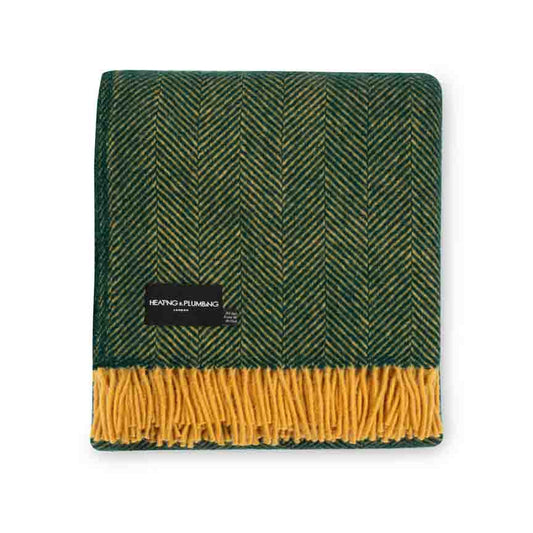
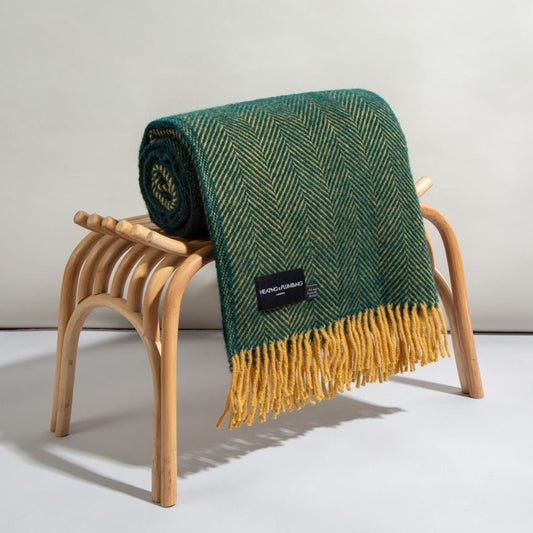
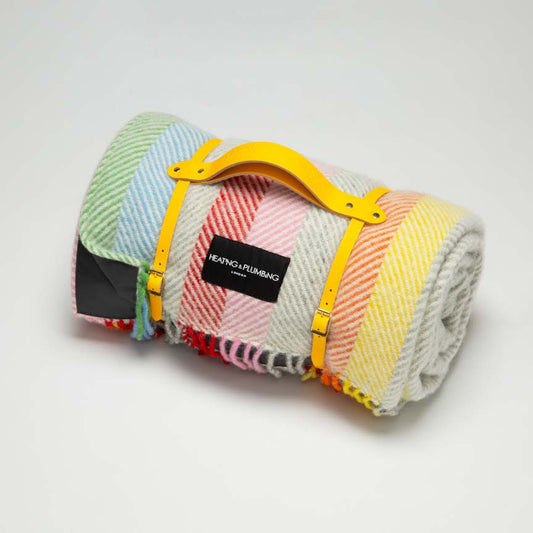
Contrast between the two yarns matters as much. Racing Green and Toffee reads warm and quiet. High contrast reads sharp and formal, which is how herringbone earned its boardroom reputation. Light Grey and Blue sits in between, while Toffee or Avocado barely raises its voice.

A herringbone throw lands in the sweet spot between plain and patterned, which is why it works over a plain sofa and a patterned one alike. Drape it over one arm rather than folding it into a tidy rectangle. Let it look used. On a person, a discreet charcoal or navy herringbone works as a non-solid solid, a pattern you can wear where patterns are frowned upon.
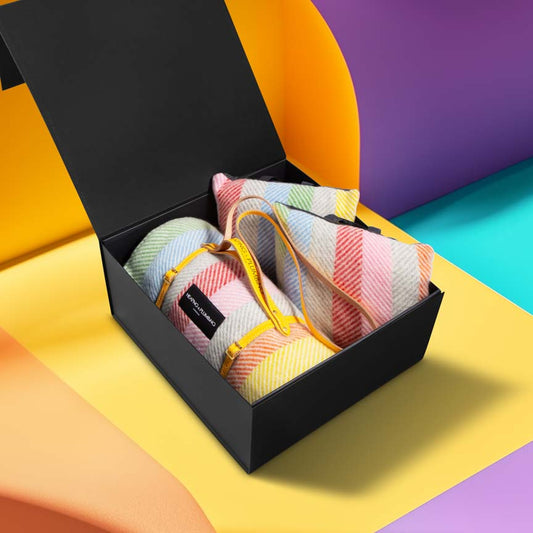
Our own Evening Tales blanket is the traditional version of it: 100% pure new wool, 183cm by 150cm, made in Britain, with its own storage bag.
Best for a sofa that needs warming up without redecorating around it. Skip it if your room already has three patterns competing for attention.
FAQ
Is herringbone a good fabric?
Herringbone is a weave rather than a fabric, so the answer depends on the fibre and the weight it is woven from. As a structure it is durable and drapes beautifully, thanks to the twill underneath. Ask what the cloth is made of before judging it.
What is herringbone cloth made of?
Anything a loom will take. Wool is the most traditional choice, especially for tweed, suiting and blanket cloth, but it is also woven in cotton, linen, silk and synthetics. The pattern describes how the yarns interlace, not what they are.
Is herringbone a winter fabric?
The pattern itself is season-neutral. Most herringbone sold in Britain is heavy wool, at 240gsm and upwards, which is why it reads as wintry. The warmth comes from the wool fibre trapping still air, not from the zigzag.
Is herringbone fabric good for summer?
In linen, cotton or silk at roughly 130-200gsm, yes, and it makes an excellent summer shirt or dress. In wool tweed at 300gsm and above, no. Same weave, opposite outcomes, which is why the name alone is a poor guide.
How do I know if my herringbone throw is woven or printed?
Turn it over. A woven herringbone shows the same interlaced structure on the reverse, while a printed one shows plain cloth with ink only on the face. Tilting it under angled light and checking the reversal points confirms it in seconds.
How do you wash a wool herringbone blanket?
Mostly, do not. Air it instead, since wool is naturally odour-resistant. Store it folded in a breathable cotton bag with cedar or lavender rather than sealed plastic, because moths are the real risk, not dirt. When a wash is genuinely due, our Evening Tales wool blankets go in the machine on a cold wool cycle and must never be tumble dried.