
















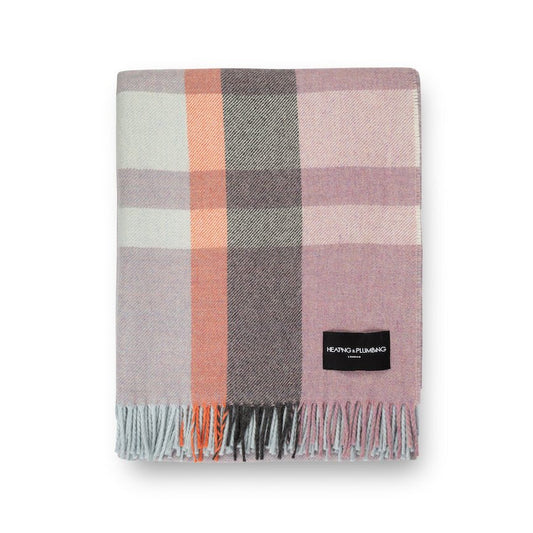

Plaid vs Tartan: The Pattern, the Garment and Why Everyone Gets It Wrong
You know the pattern. Crossed stripes, usually wool, the sort of thing that turns up on a picnic blanket, a winter scarf, or a kilt at somebody's wedding. Ask a room full of people what to call it and half will say tartan, half will say plaid, and the plaid vs tartan argument that follows will go nowhere. Both halves of the room are right.
Tartan is the pattern. A plaid, in Scotland, is a piece of cloth you wear over your shoulder. And in America, plaid is the pattern as well.
Three answers, not two. Which is why this confusion has such staying power: nobody is quite making a mistake. Two dialects are using one word to point at different things. Below we cover what a sett actually is, what a plaid actually is and how to say it, why the clan tartan story is two centuries younger than it sounds, and how to spot a printed tartan in ten seconds.
The Short Answer
If you only want the distinction, here it is.
|
Term |
What it means |
Where you'll hear it |
|
Tartan |
A specific, named pattern, built from a sequence of coloured stripes that repeats identically across the cloth and down it |
Everywhere |
|
A plaid |
A garment: a length of tartan cloth worn over the shoulder, pronounced "played", rhyming with made |
Scotland |
|
Plaid |
Any crossed-stripe pattern at all |
North America |
The neatest way to keep them apart is to listen to the grammar rather than the word. In Scotland you own a plaid, the way you own a coat. In America you buy some plaid, the way you buy some linen.
If the word takes an article, someone means the garment. If it behaves like a material, they mean the pattern.
In short: tartan is the pattern, a plaid is the thing, and America kept the word but changed what it pointed at.
What Actually Makes a Tartan a Tartan
Tartan is one of very few patterns in the world with a definition in law. The Scottish Register of Tartans Act 2008 puts it like this:
A design which is capable of being woven consisting of two or more alternating coloured stripes which combine vertically and horizontally to form a repeated chequered pattern.

Worth noting it says two or more colours, which is looser than you will often read. Plenty of writing on the subject insists a tartan needs at least three.
The repeating unit is called the sett, and it is the whole game. In a true tartan the sequence of stripes running across the cloth is identical to the sequence running down it, so the pattern mirrors itself. A sett typically repeats every five or six inches.
Underneath the sett sits the thing that makes a tartan reproducible: its threadcount. The register calls it "the DNA of a tartan", and the description is a fair one. A threadcount is the exact sequence of colours and the exact number of threads of each, written down. Hand it to any loom anywhere and the same cloth comes back.
That is the real difference between a tartan and a handsome check. One is a specification, the other is a look.
There is a weaving detail worth knowing too, because it explains something you can see. Tartan is almost always woven as a two-over-two twill, and where a stripe of one colour crosses a stripe of another, the threads blend optically into a third shade.
A tartan woven from a handful of colours can appear to hold far more. Nothing has been added. The loom is doing it.
In Scotland, a Plaid Is Something You Can Hold
The word arrived from Gaelic. Plaide means blanket, and it turns up in Scots around 1505 to 1512, which makes it comfortably older than most of what people think of as Highland tradition.
Say it "played". This is the single most useful fact in the whole subject and almost nobody outside Scotland knows it.
What makes the Scottish sense stick is seeing the actual garments, because "a plaid is a piece of cloth" is not a definition anyone remembers.
-
The belted plaid, the feileadh mòr: a long length of tartan gathered and belted at the waist, with the surplus thrown over the shoulder. A cloak by day, bedding by night, and the direct ancestor of the modern kilt.
-
The fly plaid: the rectangle pinned at the left shoulder with a brooch, the one you have seen at weddings.
-
The arisaid, the shepherd's plaid, the piper's and drummer's plaids: worn less often now, but plaids all the same.
Then the word went to sea. It travelled attached to the cloth, and North American English kept the sound while quietly moving what it pointed at, from the garment to the pattern printed across it. Neither dialect went wrong. They drifted, and now a Scot and an American can use the same word in one sentence and mean different things.

Which leaves a small circularity we rather enjoy. People search for tartan blankets and plaid blankets as though they were competing options. In Scotland the second phrase is very nearly a tautology, because a plaid was a blanket. The word began as bedding, became a garment, crossed an ocean, and came back to us as a pattern on a throw.
The Clan Tartan Story Is Younger Than You Think
Here is the version everyone repeats: Highland clans each had their own tartan, worn for centuries, so that a man could tell friend from enemy across a battlefield by the pattern on his plaid.
It is a wonderful story. It is also almost certainly not true.
The Scottish Tartans Museum puts it plainly: early tartan designs had no names and no symbolic meaning at all. Cloth was woven locally, so regional preferences emerged from the dyes local plants gave up and whichever weaver you lived near. There was no formal clan tartan system to belong to.
What actually happened took about eighty years and was largely commercial.
|
Year |
What happened |
|
c.1765 |
William Wilson & Sons of Bannockburn begin weaving tartan at scale, giving patterns numbers and names to keep them straight |
|
1815 |
The Highland Society of London writes to clan chiefs asking them to submit their tartans, obliging many to decide on the spot what theirs was |
|
1819 |
Wilson's Key Pattern Book lists around 250 of them |
|
1822 |
George IV visits Edinburgh, everybody turns out in Highland dress, and the expectation that a proper clan has a proper tartan is fixed for good |
|
1842 |
The Vestiarium Scoticum invents setts wholesale, including tartans for Lowland families who had never had one |
That last entry is the strangest. The book was published by two brothers styling themselves John Sobieski Stewart and Charles Edward Stewart, in fact John Carter Allen and Charles Manning Allen, and claimed to transcribe a sixteenth-century manuscript listing the authentic clan tartans. No one outside the brothers ever saw it. A good number of its inventions are worn today as genuine clan tartans.
None of which makes your tartan fake. A tradition assembled by Victorian enthusiasts, weavers with order books and two brothers with a talent for fiction, then lived in wholeheartedly for two hundred years, is still a real tradition. It is simply a better story than the one about the battlefield.
Tartan, Plaid or Just a Check?
Most of the mislabelling happens because a third word is missing from the argument.
A check is crossed horizontal and vertical lines forming squares, usually in two colours, with a simple regular repeat. No sett, no threadcount, no name to look up. Every tartan is a check in the loosest sense. Almost no check is a tartan.
The check family is large and mostly has nothing to do with Scotland: buffalo check, Glen plaid (the Prince of Wales check), windowpane, houndstooth, and Madras, a lightweight cotton from Chennai. Gingham is worth a footnote: it gets called a pattern constantly and is properly a fabric. "Gingham checks" is a simple check woven into cotton gingham.
Which brings us to the question everyone actually wants settled. Is Burberry a tartan or a plaid?
Both, and neither, depending on what you are asking. Thomas Burberry introduced the check in the 1920s as a lining for trench coats, and it has been trademarked ever since.

It is also, genuinely, in the Scottish Register of Tartans: search it and eight entries come back, among them Burberry (Genuine), Burberry Black and Burberry Hunting, alongside several counterfeit Burberry tartans, recorded so that fakes can be identified. Every one of the eight is filed as Corporate or Fashion. Not one is filed as Clan or District.
So Burberry is a registered tartan, and a plaid in the American sense, and has never been a clan tartan. The register's own categories, which run Clan/Family, District, Fashion, Corporate, Commemorative and Military, are the tidiest available proof that "tartan" and "clan tartan" were never the same word.
If you remember one thing here: a tartan is named and recorded, a check simply looks the part.
How to Tell a Real Tartan From a Printed One
All of this becomes useful the moment you are holding a blanket and wondering whether it is the real thing. A printed pattern photographs identically to a woven one. In the hand it does not. Four checks, no tools.
-
Turn it over. A woven tartan carries the pattern on both faces, with the twill's diagonal simply running the other way on the reverse. A printed one is blank or white on the back, because the pattern is ink sitting on the surface.
-
Check that the repeat mirrors. Compare the sequence of stripes running across with the sequence running down. In a true tartan they match. If they do not, you are holding a plaid or a check, which may be lovely, but is not a tartan.
-
Look at the crossings. Where two colours meet in a woven tartan they blend into a third shade. In a print they sit flat and separate.
-
Look the name up. A named sett can be searched in the Scottish Register of Tartans, and you can read its threadcount for yourself.
That last one is more revealing than it sounds, and our own Highland Dreams blankets make the point neatly. Stewart, Buchanan, Ramsay and Lindsay are clan names. Persevere Flint Grey is not: it is a registered fashion tartan, designed by Lochcarron of Scotland and recorded in 2017.
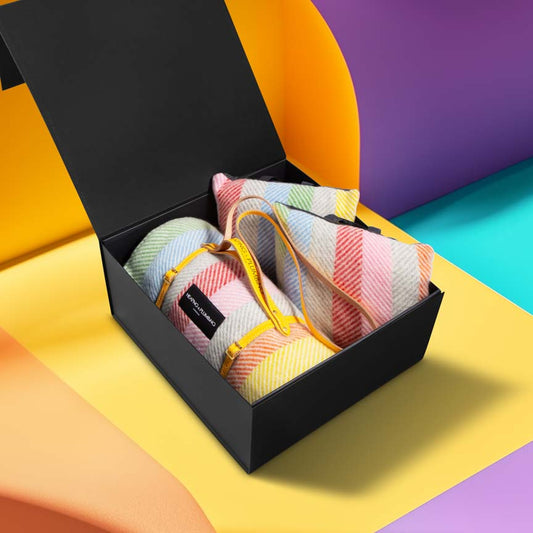
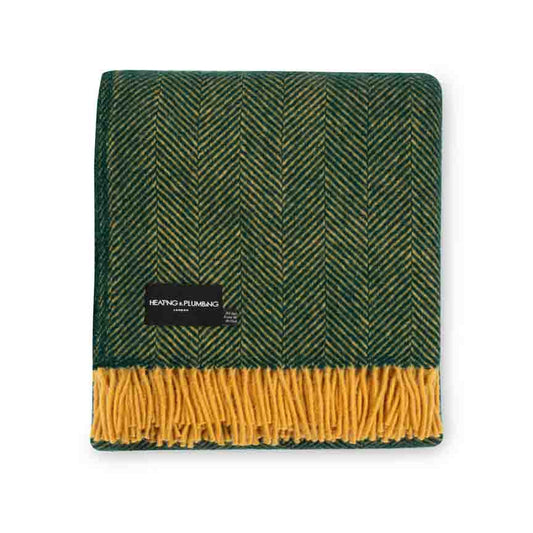
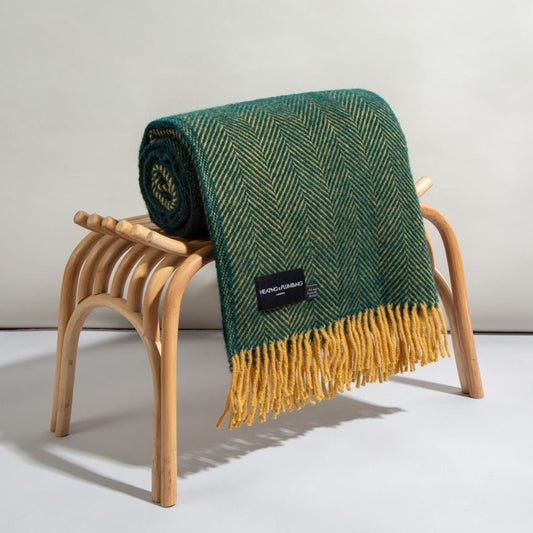
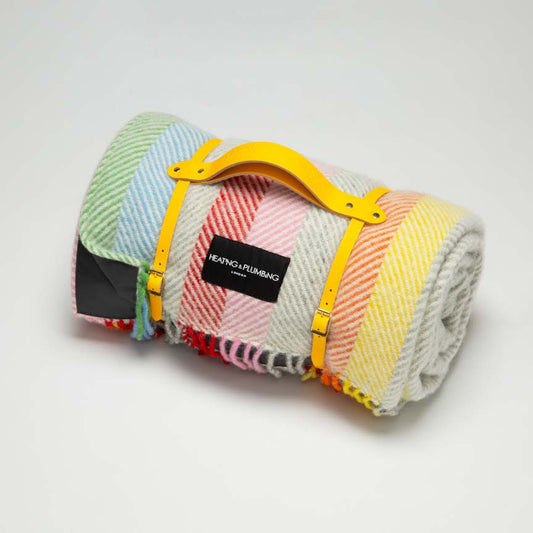
Bannockbane Silver is one of nineteen Bannockbane variants, every one filed as fashion. Same shelf, three categories, all checkable in a minute. They are woven from recycled wool, designed in our London studio and made in India. If you would rather have tartan woven closer to home, our picnic blankets are pure new wool, made in the British Isles.
One more thing, in the interest of practising what we preach. Our cashmere scarves are called Multicolour Checks and Red and Navy Blue Checks because that is what they are. Checks, not tartans.
We could call them tartan scarves and catch a little more traffic. Having spent an entire article explaining the difference, it seems a poor moment to start.
FAQ
How do Scots pronounce plaid?
"Played", rhyming with made, rather than "plad". The word comes from the Gaelic plaide, meaning blanket, and entered Scots around 1505 to 1512. The pronunciation is a reliable tell: someone saying "played" almost certainly means the shoulder garment, not the pattern.
Why do Americans say plaid instead of tartan?
Because the word crossed the Atlantic attached to the cloth rather than the pattern on it. In Scotland a plaid was the garment, woven from tartan. North American English kept the word and gradually transferred it to the design itself, so plaid came to mean any crossed-stripe pattern. Both usages are correct within their own dialect.
What is the British word for plaid?
For the pattern, tartan, or check for simpler two-colour designs with no sett. "Plaid" does exist in British and particularly Scottish use, but it names a garment: the length of tartan worn over the shoulder and pinned with a brooch. Ask for "some plaid" in Edinburgh and you will get a puzzled look.
Can anyone wear a clan tartan?
Yes. The Court of the Lord Lyon, Scotland's heraldic authority, states that there are no strict rules on who has the right to wear a particular tartan, and the Lord Lyon has no jurisdiction over tartan at all. Wearing a clan tartan conventionally signals allegiance to that chief, but it is courtesy rather than law. District tartans such as Black Watch carry no clan claim at all.
How many tartans are there?
Thousands, and we would rather give you the honest answer than a confident one. The register does not publish a running total, saying only that it holds "thousands". Figures in circulation range from about 7,000 to more than 25,000, because different bodies counted different databases and the register absorbed three predecessor registers whose records it says are still being checked.
Is a tartan blanket the same as a plaid blanket?
In American usage, yes: a plaid blanket is simply a checked one. In Scottish usage the phrase almost doubles back on itself, since a plaid was a blanket before it was anything else. What matters more than the label is the cloth. Wool traps still air and keeps its shape for decades, which is why it is worth choosing over synthetics, and why moths, not dirt, are the real threat to it.