

















How to Spot a Quality Umbrella: What to Check Before You Buy
Most umbrellas are bought in a hurry — grabbed from a pharmacy doorway as the first drops fall, or ordered online in thirty seconds based on a product photo. Most are also regretted within a season. The rib that bends on the first real gust. The canopy that leaks through the seams by October. The handle that discolours or cracks before Christmas.
The difference between an umbrella that survives years of London weather and one that doesn't isn't luck — it's a series of specific decisions made during manufacture. Once you know what those decisions look like, a quality umbrella becomes immediately identifiable. This guide walks through exactly what to check.

A note on where this comes from: H&P's umbrella collection is handmade in London in partnership with one of the UK's oldest umbrella makers. What follows isn't generic buying advice — it's what we learned from the production process itself.
Key Takeaways
- The handle is the first place corners get cut — real wood has visible grain, natural variation and no mould seam
- Hand-stitched canopy panels fit the frame precisely; machine-stamped alternatives show uneven tension at the rib tips
- A dual spring mechanism — one holding the umbrella open, one holding it closed — is the mark of considered construction
- The shaft material matters less than the quality of its construction — a hand-finished wooden shaft from FSC-certified timber is a mark of craft, not compromise
- Gunmetal or solid metal tip caps outlast plastic ones significantly; check these before buying
- A quality umbrella opened and closed with care, dried properly after use and stored correctly should last a decade or more
The Handle: The First Thing You Touch and the Last Place to Cut Corners
Pick up any umbrella and your hand goes straight to the handle. It is also, reliably, the component where budget umbrellas make their most visible compromises.
Real wood versus imitation wood
A genuine wooden handle — beech, maple, chestnut — has visible grain, natural colour variation and a slight irregularity that no moulded plastic can convincingly replicate. The giveaway on an imitation wood handle is the mould seam: a faint line running along the underside where the two halves of the plastic mould were joined. Real wood has no seam. It also has weight — a solid wood handle feels substantive in the hand in a way hollow or plastic alternatives do not.

H&P's maple handles are sourced from North America, then bent, scorched and lacquered by hand in Italy. The scorching process — applying controlled heat to the wood surface — is a mark of genuine craft: it deepens the grain, hardens the surface and produces a finish that develops character with use rather than simply degrading.
The crook shape
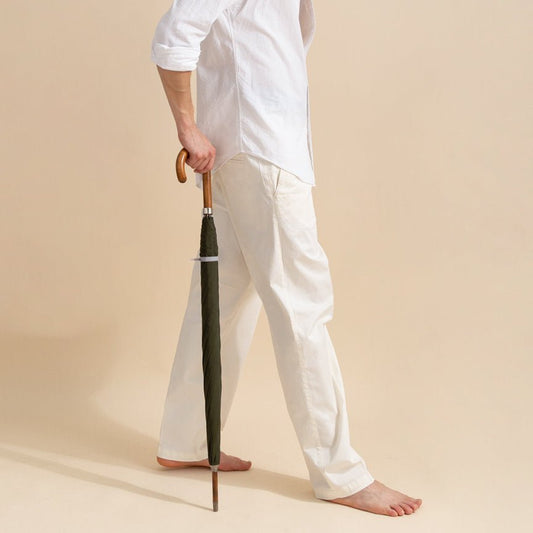
A curved crook handle is not merely traditional — it is functional. It allows the umbrella to hang from a wrist, an arm or a coat hook without a strap or loop. A straight handle requires a separate attachment point; a crook does not. This is a practical decision that also happens to be the more elegant one.
The curved handle was one of the first decisions we made in designing our collection — not for aesthetics but because it is simply the more useful shape. An umbrella you can hook over your arm while you unlock a door is an umbrella you will actually use.
The Canopy: Stitching Is Where Quality Shows Under Pressure
The canopy has one job — keep you dry — but the way it is constructed determines how long it does that job and how well it performs under stress.
Hand-cut versus machine-stamped panels
Each panel of a quality umbrella canopy is individually cut and hand-stitched to the frame. This takes considerably longer than machine production but produces a canopy where the fabric sits in precise tension across the frame — neither pulling nor sagging. H&P's canopy panels are hand cut and assembled over the frame by hand, a process that is visible in the even tension of the finished canopy.
Run a finger along the seams where the panels meet. What to look for:
- Tight, even stitching with no loose threads or uneven spacing
- Reinforcement at the rib tips — the highest-stress points, where the fabric pulls every time the umbrella opens and closes
- A separate, reinforced inner cap at the central top point, not simply gathered fabric held by a single stitch
H&P's umbrellas have contrasting inner caps — a detail that simultaneously strengthens the central core of the panels and provides a considered design accent visible when the umbrella is open.

The fabric itself
H&P's canopy fabric is sourced from Japan — high-quality polyester that is sun-resistant and colour-fast. The thread count matters: thinner, cheaper polyester lets light through when held up to a window and feels slightly translucent. Quality fabric does not. A simple test: hold the canopy up to natural light. If you can see clearly through it, the fabric is too thin.
The water test
Drop a small amount of water onto the canopy fabric. On a properly coated canopy, the water beads up and rolls off cleanly — it sits on the surface like droplets on a waxed car. On a cheaper canopy, the fabric darkens immediately as the water soaks in.
The Frame and Ribs: What Keeps the Whole Thing Open
The frame is where cheap umbrellas most visibly fail, and where the difference between a quality and a budget purchase becomes physically obvious — usually in the first serious wind.
Rib construction and joint quality
Open the umbrella and look at where the ribs meet the runner — the piece that slides up the shaft when you open it. On a cheap umbrella, these joints are crimped plastic, which works until it snaps. On a quality umbrella, they are metal, properly fixed, and designed to flex repeatedly without fatigue.
| Rib joint type | Material | Expected lifespan |
|---|---|---|
| Crimped plastic | Budget manufacture | Months |
| Pressed metal | Mid-range | Several years |
| Reinforced metal hinge | Quality manufacture | A decade or more |
Flex the ribs gently with the umbrella open. The movement should feel even and controlled across all ribs simultaneously. Rattling, asymmetric movement or stiff spots in individual ribs are signs of inconsistent manufacture.
The dual spring mechanism
A quality umbrella has two springs: one at the top that holds the canopy open at the correct position, and one at the bottom that holds it neatly closed. This is what gives a well-made umbrella its satisfying, positive action — a click into the open position and a secure closure. A single spring or a sliding catch is a simplified construction that saves manufacturing time at the cost of longevity and feel.

H&P's spring mechanism is installed by hand during assembly in London — a step that sounds minor but is critical to ensuring the umbrella stays reliably open in the top position rather than creeping down under wind pressure.
The Shaft: More Than Just a Pole
The central shaft is the structural backbone everything else attaches to, and it is where material choice and construction quality interact most directly.
Wood versus metal: the real question
Some buying guides position a metal shaft as automatically superior to wood. This misses the point. A hand-finished wooden shaft from FSC-certified timber, made by craftsmen who have been producing umbrella shafts for generations, is not a compromise — it is a choice that prioritises craft, material authenticity and longevity over standardisation.
H&P's beech shafts are handmade in Cheshire using FSC-certified wood and hand stained in Kent. The shaft is machined with a groove that holds the spring mechanism in precise alignment — invisible to the eye but essential to the umbrella's function. This level of regional, traceable provenance is simply not present in mass-market production.
A metal shaft, by contrast, is consistent and lightweight. Both are valid choices in a quality umbrella. What matters in either case is that the shaft connects cleanly to the handle and the runner without play or wobble, and that the mechanism groove holds precisely.
The balance test
Hold the umbrella by the handle and feel how it sits. A well-made umbrella is slightly handle-heavy — the weight of the canopy and frame counterbalances the grip naturally. An umbrella that feels top-heavy or awkward to hold has compromised the handle to save material cost where it matters most.
The Hardware: Small Details That Reveal Everything
The metal components of an umbrella — tip caps, ferrule, runner — are small enough to overlook in a shop but significant enough to determine how long the umbrella actually lasts.
Tip caps
These are the small metal pieces at the end of each rib that keep the canopy fabric attached to the frame. On cheap umbrellas they are plastic, and they crack, snap or simply pull away from the rib within a season. On a quality umbrella they are solid metal — H&P uses gunmetal throughout. Tap them gently. A hollow sound indicates plastic; a dull, solid sound indicates metal.
The ferrule
The ferrule is the metal tip at the very bottom of the shaft — the crowned end that meets the ground when the umbrella is used as a walking aid. On a quality umbrella it absorbs the shock of contact rather than transmitting it to the wooden shaft, which would eventually split. It also gives the umbrella its finished length. A well-fitted ferrule sits flush and moves slightly under pressure; a poor one rattles.
The tie
The colourful tie that holds the umbrella closed until you are ready to open it is a detail that signals the manufacturer's overall approach to finish. A quality tie is properly hemmed, holds securely and releases cleanly. A cheap one is a piece of ribbon tacked on as an afterthought. H&P's ties add a considered splash of colour — a small detail that is indicative of the attention paid to every other component.
What All of This Looks Like Together
A quality umbrella is not defined by any single component but by the sum of decisions made across all of them. When the handle is real wood, finished by hand. When the canopy panels are hand-cut and stitched, with reinforced tips and a contrasting inner cap. When the shaft has a machined groove holding a dual spring mechanism installed by hand. When the tip caps are gunmetal and the ferrule sits flush. When the fabric is sourced for quality rather than cost. When all of those decisions are made deliberately and with craft — that is what a quality umbrella feels like when you pick it up.

H&P's umbrellas are handmade in London, with components sourced across the UK, Italy, North America and Japan. The collection is the result of working closely with one of Britain's oldest umbrella makers and learning, component by component, what those decisions actually cost and why they are worth making.
Shop the H&P umbrella collection →
FAQs: Umbrella Quality
How long should a quality umbrella last?
A well-made umbrella that is properly cared for — opened and closed with care, dried fully after use, stored away from heat sources — should last ten years or more. The components most likely to fail first in a quality umbrella are the canopy fabric and the tip caps, both of which can be repaired or replaced by a specialist rather than requiring the umbrella to be discarded entirely.
What is the difference between a cheap and an expensive umbrella?
The differences are structural rather than cosmetic. Cheap umbrellas use plastic rib joints that snap under stress, single-spring mechanisms that lose tension quickly, machine-stamped canopy panels with loose stitching, and imitation wood or moulded plastic handles. Expensive umbrellas use reinforced metal joints, dual spring mechanisms, hand-stitched panels, and real wood or leather handles finished by hand. The visible difference in a shop is subtle; the difference after eighteen months of real use is significant.
Are wooden handle umbrellas better than other types?
A genuine wooden handle — properly shaped, finished by hand and made from quality timber — is more durable, more comfortable to hold over time and develops a patina with use that plastic handles do not. The key word is genuine: imitation wood moulded from plastic offers none of these benefits. Real wood has visible grain, natural variation in colour and no mould seam. If you cannot see these characteristics, the handle is not solid wood.
What is a ferrule on an umbrella?
The ferrule is the metal tip at the bottom of the umbrella shaft. It serves two purposes: it gives the umbrella its finished length and it absorbs the shock of contact with the ground when the umbrella is used as a walking aid, protecting the wooden shaft from splitting under repeated impact. On a quality umbrella the ferrule fits flush and is made from solid metal; on a cheap umbrella it is often plastic and the first component to crack or come loose.
Why do cheap umbrellas break so easily in the wind?
Most cheap umbrellas fail in wind because their ribs are made from rigid steel that bends permanently under pressure rather than flexing and recovering. The rib joints are also typically crimped plastic, which snaps rather than flexing. A quality umbrella uses reinforced metal joints and may use more flexible rib materials that absorb wind force rather than resisting it rigidly. The canopy construction matters too — a hand-stitched panel fitted to precise tension holds under stress better than a machine-stamped one.
Is a handmade umbrella worth the money?
If you use an umbrella regularly in British weather — which is to say, frequently — yes. A handmade umbrella bought once and maintained properly costs considerably less per year of use than a sequence of cheap replacements. It also performs better, looks better and can be repaired rather than discarded when individual components wear. The investment case is straightforward; the harder question is simply finding one made with the craft the price implies.
What should I look for in an umbrella made in the UK?
British-made umbrellas vary considerably in quality depending on the maker. Look for FSC-certified timber in the shaft, hand-stitched canopy panels, solid metal tip caps and ferrule, a dual spring mechanism installed by hand, and a handle made from genuine wood or leather rather than moulded plastic. Ask specifically where each major component comes from — a maker who knows their supply chain in detail is a maker who cares about what goes into the product.