

















How to Style a Throw on a Sofa
You have folded it, tossed it, stood back, and refolded it. The throw still looks less styled than abandoned, and you cannot quite say why. Most guides on how to style a throw on a sofa hand you seven interchangeable ideas and no reason to prefer any one of them.
Half the time the problem is not your technique. It is the throw itself, because weight, weave and size decide what any draping method can achieve.
Seven steps follow, in order, each with the reason it works. Start at the top and you will know within a minute whether you have a styling problem or a shopping one.
Step 1: Start With Weight and Weave, Not With Technique
Before you touch the throw, look at the label. Every technique below is wasted on the wrong fabric.
Weight comes first. The brackets that matter:
-
Acrylic and polyester fleece: 200 to 350gsm
-
Wool blankets: 350 to 500gsm and beyond
-
Cashmere throws: roughly 300g for a lightweight piece, up to 500g for a heavy winter one
A fleece sitting in that lowest bracket has too little density to hold a fold, so it flattens against the seat instead of falling in soft folds.
Weight alone is not the whole answer, which is where most advice stops short. A 250gsm wool blanket can drape with more structure than a 400gsm cotton one.
Fibre does as much work as grammage.
Then construction, which decides the rest. Woven fabric interlaces warp and weft yarns at right angles on a loom, which keeps it structurally stable: it holds a clean, formal line and keeps a crease. Knitted fabric is a single continuous looped yarn, so it stretches and moulds to whatever it is lying on, which reads casual and lived-in.
Neither is better. They produce different looks, and that difference is the hinge Step 4 turns on.
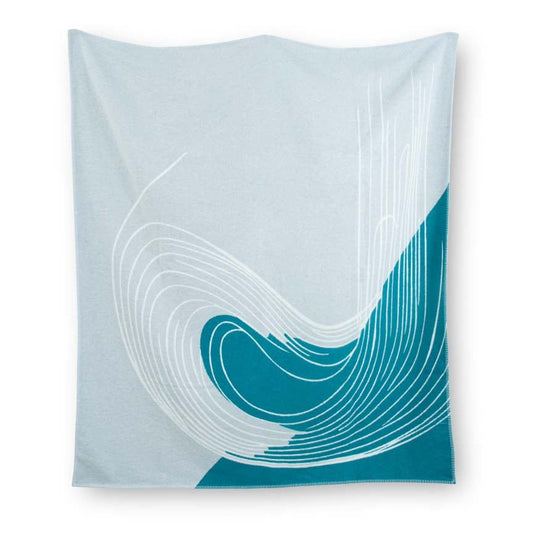
Our own cashmere throws sit firmly at the woven end. 100% cashmere, yarn spun in Italy, woven in the British Isles. Love Stories is 200cm x 145cm at £390, enough fabric to run across a seat and still fall properly down the front of an arm.
If you are buying rather than restyling, weight is the specification to check first.

Step 2: Check the Throw Is Big Enough Before You Blame Yourself
An undersized throw reads as a postage stamp rather than a drape, and no amount of rearranging will talk it out of that.
Use the diagnostic, not a chart. If the throw does not hang meaningfully past the seat cushion on the side it falls, it is too small for your sofa, whatever the label calls it. A lap or chair throw of roughly 102 x 137cm will always look lost on a 2- or 3-seater, and a typical UK 3-seater is around 200cm long.
If you already own it and cannot replace it, lay it on the diagonal rather than square. It then drapes down the side and reads as deliberate rather than short.
The full breakdown by sofa and bed size lives in our throw blanket size guide.
If the throw is genuinely too small, nothing in this article will fix it. Worth knowing before you spend an evening rearranging.
Step 3: The Two Thirds Fold, Draped Over the Arm
The 2/3 rule is one of the most quoted numbers in interior design, and almost nobody applying it to a throw is using the right version of it.
In its common form it is an object-to-object sizing ratio: a sofa fills about two thirds of the wall it sits against, a coffee table runs about two thirds of the sofa's length, art above it spans about two thirds of its width. All useful. None is about throws.
The throw version is a fold ratio, not a size ratio. That distinction is what the rest of the internet keeps skipping.
-
Lay the throw flat and fold it lengthwise into thirds.
-
Lay the folded strip over one armrest, not across the middle of the sofa.
-
Position it so roughly one third falls down the front of the arm and two thirds runs back across the seat.
-
Leave the arm itself partly visible rather than swallowing it whole.
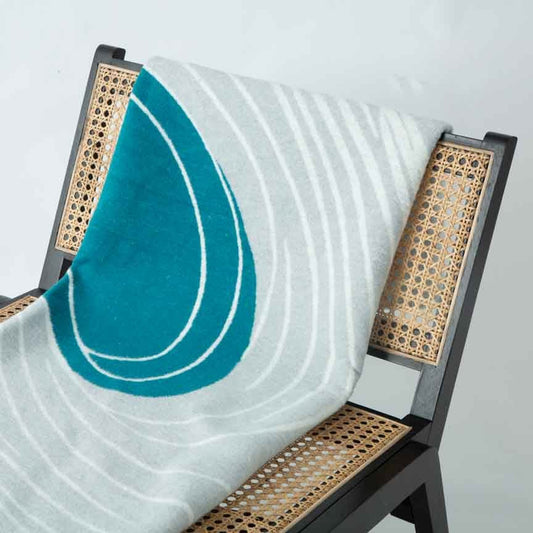
Off-centre is the entire point. Centring the throw creates symmetry where there should be ease, which is why a perfectly balanced arrangement reads as staged. The HGTV designer Ken Wingard puts it from the other direction: grab a point roughly 30 to 45cm (12 to 18 inches) off centre, never the centre itself, toss it over the corner, and leave enough hanging that the throw shows past the cushion and falls slightly over the front seat.

The interiors press and working home stylists describe this in near-identical language, usually a sign a technique is real working practice rather than one blog's invention.
Compare it with the version most of us default to: a neat square, folded twice, centred on the seat. Tidy, symmetrical, and unmistakably a showroom rather than a room anybody lives in.
Step 4: Decide Whether You Are Folding or Draping
One question settles this, and it takes about five seconds to answer. Is your sofa tailored, or is it relaxed?
A neat fold in thirds or quarters reads formal and tidy. A looser off-centre drape reads easy and lived-in. Treat it as a spectrum running from most casual and free-flowing at one end to properly button-down at the other, then place your sofa on it.
Three criteria decide where it lands:
-
The sofa's line. A structured, buttoned silhouette such as a Chesterfield takes the fold, because the fold echoes a shape that is already tailored. A low modern sofa, or anything with a deep and soft seat, takes the drape.
-
The fabric. Back to Step 1. A woven throw holds a crisp fold, a knitted one will not, so a knit is happier draped.
-
How hard the sofa works. A fold on a sofa that gets sat on all evening will not survive to breakfast.
For the tidy version, fold the throw in half and then in half again for a long strip, or into thirds lengthwise and then in half, then tuck it over the arm so it stays within reach without looking dumped. It still needs to hang a decent amount either side to read as size-appropriate rather than skimpy.
If your sofa is genuinely somewhere in between, drape it. A slumped fold looks worse than a shifted drape, and the drape forgives a family evening in a way the fold never does.
Step 5: Layer the Throw With Your Cushions
The throw wants the same corner as the cushions. When they compete for it, the sofa ends up crowded on one side and bare on the other.
Give them different corners. If the throw takes one arm, weight the cushions towards the other, or keep the cushions sitting inboard so the throw still shows past them rather than disappearing behind. That visible margin, the same one from Step 3, is what stops the throw reading as something shoved down the back.
Then the palette. A throw matched too closely in colour to the sofa or the cushions reads as an afterthought. Matching sets work beautifully under bright retail lighting. In a real room with a rug, art and warm lamps, nothing connects a matched set to anything else.
Keep the palette related and vary the surface instead: a smooth, a woven, a nubby.
Match the palette. Contrast the texture.

And know when to stop. If you have to move a mountain of cushions before a guest can sit down, you have too many. Balance rather than abundance, with fewer pieces placed on purpose.
The sofa, throw and cushions all in one obedient colour is the commonest version of a living room that looks oddly flat. One chunky or nubby piece, in a shade already somewhere in the room, is the whole fix.
Step 6: Stop It Sliding Off Leather or Velvet
A drape you arranged beautifully at seven is on the floor by eight. The fix is one decision, not a gadget.
Friction comes from the throw's surface, not from anything you do to the sofa. A smooth acrylic throw on leather or velvet has almost nothing to grip with, so gravity gets on with it.
Choose a textured weave, a chunky knit or faux fur and the problem largely goes away. Non-slip latex and silicone backings are the gimmicky route. Fibre choice is the real one, and the second reason after drape to prefer a textured natural fibre.
Two anchoring techniques help once the fabric is right:
-
The triangle fold. Fold the throw into a triangle and let the heaviest section fall behind the back of the sofa, so its own weight holds the rest in place.
-
The full tuck. Push the edges into the gaps between the seat cushions, the back and the arms. Less elegant, far more durable, and the sensible choice on a sofa that gets used.
On a smooth, buttoned, formal sofa, texture contrast is also what makes a throw look deliberate rather than accidental. The grip fix and the styling fix are the same decision.
For leather or velvet, buy for texture before you buy for colour.
Step 7: Styling a Corner or L Shaped Sofa
Corner-sofa advice rarely works because almost all of it was written for a 3-seater. A corner unit breaks the assumption underneath it: that there is a single arm and a single visual centre.
Scale is the first problem. A UK corner unit typically runs between 250 and 300cm across, so a throw that looked generous on a 3-seater is a smudge on it. That is not an argument for one enormous throw.
Two throws beat one, and the reason matters more than the instruction:
-
A larger, quieter throw across the back of the longest run gives the sofa a base.
-
A smaller textured or accent piece on the chaise or the inside corner gives it depth.
Style only the chaise, the common mistake, and it reads as disconnected from the main seat. On slippery upholstery there is a practical bonus straight from Step 6: two narrower throws anchor far more reliably than one oversized piece.

Then the corner itself, where these sofas look either bare or like a pile of laundry. Lay a throw over the junction where the two sections meet and let it fall over the back and part of the seat on both sides. It softens the hard right angle, and works best with a textured fabric.
On a heavily used sofa, do the full tuck instead.
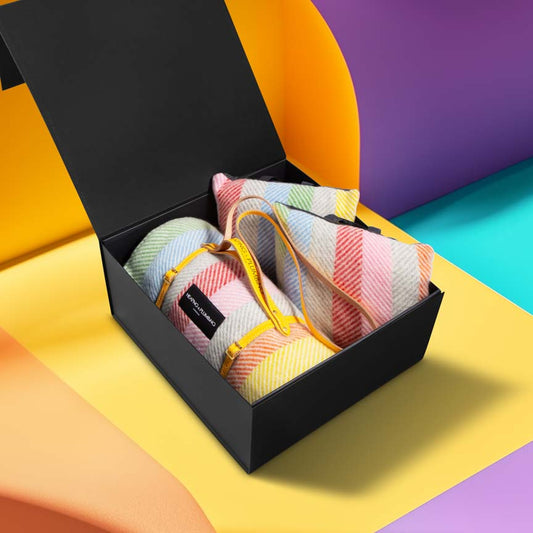
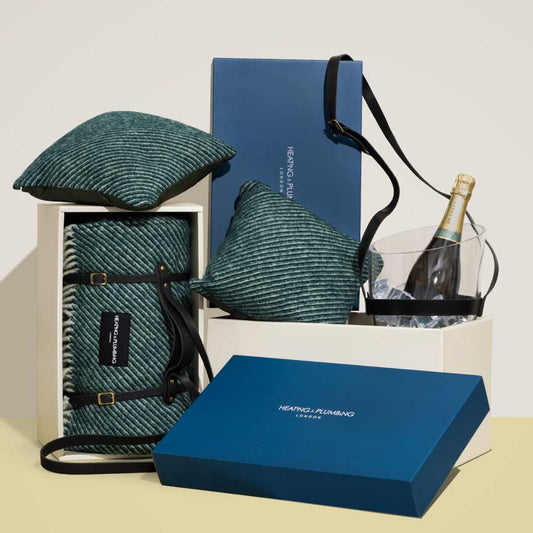
It helps to own one throw with enough body to do as it is told, which is broadly why we weave ours in the British Isles and send them out in a gift box with a cotton storage bag, in case the sofa in question is not yours.
FAQ
How many throws should you have on a couch?
One or two on a standard sofa. Three or more reads as clutter rather than comfort. A corner sofa can carry two, occasionally three, provided they vary in size and texture across the sections.
What is the 2/3 rule for a sofa?
Usually an object-to-object sizing ratio: the sofa fills about two thirds of its wall, the coffee table about two thirds of the sofa's length, art about two thirds of its width. The throw version is a fold ratio instead. Fold lengthwise into thirds, then drape so one third falls down the arm and two thirds runs across the seat.
How do you use a throw to cover a whole sofa?
Spread it flat across the seat and back, then push the edges deep into the gaps between the cushions, the back and the arms so it resists shifting. Full coverage needs a much larger piece than a decorative drape, so check the dimensions first in our throw blanket size guide.
How do you display throws in a living room?
Fold the throw two or three times into a neat rectangle and lay it over an ottoman, or keep it in a basket by the door. Fold rather than hang. Hanging stretches wool and cashmere fibres and permanently changes how the throw falls.
How do you keep a wool or cashmere throw looking styled?
Air it, shake it out, and fold rather than hang it, which preserves the drape. Woven cashmere throws, including ours, are labelled dry clean only. For knitted cashmere and wool pieces, how to wash cashmere covers the safe routes.