



















How to Wash Cashmere: A Careful Guide for Scarves and Throws
Cashmere is not fragile, it is specific. It has one real enemy, and once you know what that is, how to wash cashmere stops being a leap of faith and becomes a short, calm routine. Nine steps below, for scarves and, because a two-metre throw is a genuinely different job, blankets too.
Step 1: Check the Label and the Weave Before Anything Touches Water
Thirty seconds with the label and one gentle tug at the fabric tells you whether your piece belongs in water at all. It is the step everyone skips, and the only one that is truly unforgiving.
Knitted or woven? Knitted cashmere has visible loops and stitch structure, and it gives when you pull gently across it. Woven cashmere has a flat criss-cross face, barely stretches, and usually finishes in a cut or fringed edge. Fine blankets and lighter scarves are very often woven, so do not assume. Johnstons of Elgin, a Scottish mill in business since 1797, sends woven pieces to a professional cleaner, because the drape and the fringe are exactly what you stand to lose. Our own Eternal Edition cashmere scarf is woven and fringed, and labelled dry clean only for precisely that reason.

Decode the circle. A circle with a P inside means traditional perchloroethylene dry cleaning. A circle with an F means the gentler hydrocarbon method. Ask for F where a cleaner offers it, as Johnstons themselves recommend.
And the verdict. For knitted cashmere, hand washing wins. Perc works because it dissolves oil and grease, and it cannot tell the difference between the grease you want gone and the natural oils that keep a protein fibre supple. Dry cleaning still earns its £8.90 to £12.50, more in London, for lined, structured, beaded or trimmed pieces, for woven and fringed scarves, and for anything carrying a serious stain.
So: soft, stretchy and stitched, it goes in the sink. Flat, firm and fringed, it goes to the cleaner.
Step 2: Understand the One Thing That Actually Ruins Cashmere
Cashmere does not really shrink, at least not the way people picture it. It jams.
Every fibre is wrapped in microscopic overlapping scales, like tiles on a roof. Warmth and moisture make those scales lift away from the shaft. Add agitation, rubbing, twisting, the churn of a machine drum, and fibres are pushed past one another until the raised edge of one scale catches in the gap between the scales of the next. They ratchet one way and cannot slide back.
Not shrunk. Locked.
Which is why "does 100% cashmere shrink?" has two answers, not one:
-
Relaxation shrinkage. The fibres have simply contracted. The knit structure is still visible and the fabric still gives when you press it. Mild, and often partly recoverable. See Step 8.
-
Felting shrinkage. Rigid, dense, matted, the stitches gone. This is the ratchet, and it is permanent.
Some wool is sold as "superwash", with the scales chemically stripped or filled in with resin so they cannot interlock at all. Cashmere is essentially never treated that way, which is why the rules are different.
Three levers, then: heat, agitation and friction. Everything from here is about keeping all three low.
Step 3: Choose a Detergent That Will Not Eat the Fibre
Biological detergent is engineered to digest protein. Cashmere is protein. You can see the difficulty.
The enzymes in bio powders and liquids break down protein-based stains, and they cannot distinguish between the egg on your collar and the keratin the fibre itself is made of. Woolmark's guidance is unambiguous: a neutral, mild, ideally Woolmark-recommended wool wash, and no bio detergents, no bleach, no heavy-duty formulas.
The shelf check, in four seconds:
-
Look for non-biological on the front of the bottle.
-
Look for the Woolmark logo.
-
Scan for the words enzyme or protease. If either appears, put it back.
-
Walk past the fabric conditioner entirely.
Real options: Ecover Delicate Laundry Liquid for Wool & Silk is Woolmark-approved, pH-neutral and enzyme-free. Woolite's enzyme-free formula is on most supermarket shelves. The Laundress Wool & Cashmere Shampoo sits at the premium end, though UK stocking varies. Baby shampoo is a legitimate stand-in: near-neutral pH, no enzymes or harsh surfactants, and hair is keratin too.

Which leaves the conditioner. Woolmark's position: softener lubricates the fibres and lets them migrate to the surface, increasing pilling rather than preventing it. Ariel's own cashmere page recommends Lenor, and Google's AI Overview cites it approvingly. We would only gently observe that the company selling the conditioner is not the most disinterested party in the room.
Step 4: Hand Wash a Scarf in the Sink
Every guide to how to wash cashmere gives a different temperature and a different soak time, and not one of them admits the others exist. So here is one clear answer: cool to lukewarm, roughly 20 to 30°C, and cooler still, around 15 to 20°C, for a brand-new piece's very first wash.
-
Fill the sink with cool water and dissolve the wool wash completely before the piece goes in. Neat detergent on dry cashmere is an avoidable risk.
-
Submerge and press gently. Open and close your hands around the fabric. No rubbing, no scrubbing, no twisting.
-
Soak for 10 to 15 minutes. Longer only if it is genuinely grubby.
-
Drain and refill with clean water at the same temperature, press again, drain again, and repeat until no suds appear.
-
Press the water out with flat hands against the side of the sink.
Why the spread? Published guidance runs from a vague "warm" at M&S through 20°C at Gobi to 30°C at Ariel, with Clothes Doctor alone separating a first wash from later ones. Soak times run from "a few minutes" to a full half hour. Both scale with how soiled the piece is, and temperature matters far less than the absence of agitation. Step 2 explains why.
One note for London and the South East. Hard water can leave cashmere feeling slightly stiff and chalky, and the fix is more rinsing, not more detergent. A splash of white vinegar in the final rinse is cheap, low-risk and worth trying.
All of which assumes the thing fits in a sink.
Step 5: Wash a Cashmere Throw or Blanket in the Bath
Saturated, a full-size throw can weigh close to double what it does dry.
Clean the bath first and rinse it thoroughly. Residual bathroom cleaner is a real risk that nobody mentions.
-
Fill with cool water and dissolve the wool wash fully before the throw goes in.
-
Lay it in and press down across the whole surface until it is evenly saturated. Do not stuff it in and hope.
-
Soak for 15 to 20 minutes without agitating. A large piece takes noticeably longer to wet through.
-
Drain, refill, and rinse by lifting and squeezing the water through the fabric rather than swirling it about. Repeat until the water runs clear.
-
Press out as much water as you can while it is still lying in the bath.
Then lift it properly. Never by a single corner: the entire wet weight hangs from a few centimetres of fabric and stretches it permanently. Gather it up, support the full width, and do not carry it dripping across the house.
You will need to do this rarely. Woolmark suggests wool blankets need washing as infrequently as once every three months, and often less. A throw living on the back of a sofa is not being worn against skin all day.
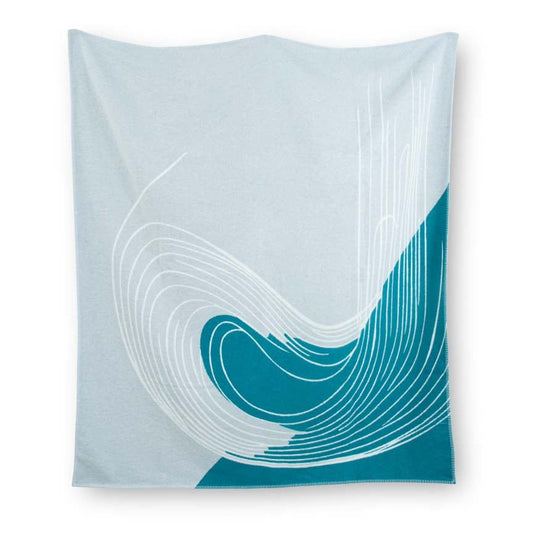
One caveat we would rather give you than leave out. Our own cashmere throws are woven rather than knitted, and the Love Stories blanket is labelled dry clean only, which is the honest answer for a fine woven piece however inviting the bath looks. Run your own throw past Step 1 before you fill anything. For a knitted wool throw, our guide to washing and drying a wool blanket covers much the same method.
You should now be holding something clean, extremely heavy, and entirely without a home.

Step 6: Get the Water Out and Dry It Flat
Most cashmere is not ruined in the water. It is ruined in the ten minutes afterwards.
Never wring, twist or scrunch. That is agitation plus weight, which is the felting recipe from Step 2 almost exactly. Press instead. Then use the towel roll: lay the piece flat on a dry towel, roll the two up together, press along the length of the roll, then unroll onto a second dry towel. While it is still damp, reshape it to its original dimensions. That is the moment the shape is set, and the moment does not come again.
One airer bar leaves a crease line, and on anything heavy, a stretch line that never quite drops out.
Lay towels across a spare bed, a table, or the floor over a clean sheet. For a throw, two airers side by side beat a single bar. Change the towel underneath once it is saturated rather than leaving the piece sitting in the water it has just released. Keep it away from radiators and direct sun throughout, both of which are heat, and heat is one of the three levers.
Timings: roughly 24 hours flat for a scarf, and 24 to 48 hours for a full-size throw. Anything put away even slightly damp comes out musty, and bone dry is non-negotiable before storage, which is Step 9.
The only equipment this step genuinely requires is patience, which is annoyingly the one thing we do not sell.
Step 7: Work Out Whether That New Fuzz Is Normal
You have lifted it off the towel and it looks hazy. Soft, but fuzzy in a way it was not before. In most cases this is good news, and there is a simple test.
Feel it. Soft and fuzzy is bloom, the halo, and it is completely normal: short fibres inside the yarn work loose and rise to the surface. Hard and flat is felting damage, where the stitch structure has disappeared into something board-like. Soft means you have done it right. Rigid means Step 8.
The part nobody explains is that the brushed finish giving good cashmere its halo has already loosened those surface fibres, so premium pieces often pill more visibly at first rather than less. Long-fibre cashmere pills less than short-fibre blends, simply because there are fewer loose ends to begin with.
To tidy it, use a cashmere comb on fully dry fabric only, never wet. Firm flat surface, good light, roughly 45 degrees, light strokes in one direction with the knit. Then let it rest and wear it, because the halo settles on its own.
If it is soft, it is fine.
Step 8: Rescue Cashmere You Have Already Shrunk
If you have found this article too late, no lectures. Only the honest answer about whether a rescue is worth attempting.
Press the fabric first. If it still gives and you can see the knit structure, that is relaxation shrinkage and worth a go. If it is rigid and dense and the stitches have vanished into a board, that is felting. It is permanent, and no soak, stretch or steam will bring it back. As one care guide puts it, once it has turned to felt there is not much you can do.
For the recoverable kind:
-
Act sooner rather than later.
-
Stir roughly two tablespoons of baby shampoo or hair conditioner into lukewarm water until it feels faintly slippery.
-
Submerge the piece fully and soak for 30 minutes, up to a couple of hours for a stubborn case, but not overnight: prolonged soaking degrades the fibre.
-
While still damp, stretch it gently back towards its original measurements.
-
Pin or block it flat on a towel and leave it to dry completely, undisturbed.
Set expectations honestly: a badly shrunk piece often comes back only part of the way.
Better never to need this. Which is largely a question of how you put it away.

Step 9: Store It So It Survives Until Next Winter
Moths are not really after your cashmere. They are after what is on it.
Something that looks perfectly clean can still be a feast. Wash before you store, every time, and the most effective anti-moth measure there is has already been taken.
If you are already dealing with them, the freezer method works on cashmere as well as it does on wool.
Never vacuum-seal it. Compression denies the fibre airflow and can permanently crush the loft and softness out of it, and airing afterwards will not bring them back. Breathable cotton garment bags with cedar instead, and fold rather than hang, so the shoulders are not slowly stretched by their own weight.
Make sure it is bone dry going in, as Step 6 insisted. Damp in July is musty in October.
Cashmere tends to be the sort of thing people are given rather than buy for themselves, which is rather the point of gifting it. Looked after properly, a good piece lasts years rather than seasons, which was always the reason it cost what it did.
FAQ
Can you machine wash cashmere?
Sources genuinely disagree. Several retailers, including M&S, Ariel and Clothes Doctor, permit a wool or delicate cycle at cold temperatures in a mesh bag with a slow spin, around 600 to 800rpm. Others, including Sofia Cashmere and Johnstons for woven pieces, say no. Hand washing removes the agitation risk entirely, which is why specialists still prefer it. Never machine wash a large throw.
How often should you wash cashmere?
Far less often than you think. Published figures span three to four wears (Johnstons, Gobi), three to five or six to eight (Clothes Doctor, contradicting itself across two of its own articles, which tells you there is no settled number), and around ten (N.Peal, citing cashmere's natural antibacterial properties). The practical rule: wash when it is actually soiled, and rest it 24 hours between wears otherwise. Woolmark puts blankets at roughly once every three months.
Is it better to hand wash or dry clean cashmere?
Hand wash knitted cashmere, and dry clean the rest. Perc, the traditional dry-cleaning solvent, strips natural oils from the fibre over repeated cleanings and leaves it feeling less soft. Reserve professional cleaning for lined, structured, beaded or trimmed pieces, for woven and fringed scarves, and for anything with a serious stain. Ask for the gentler F method where a cleaner offers it.
Is baby shampoo any good for washing cashmere?
Yes, legitimately. Baby shampoo is near-neutral in pH and free of the enzymes and harsh surfactants in ordinary laundry products, and hair is keratin just as cashmere is, so it is formulated for very similar material. Treat it as a genuine budget alternative rather than a compromise on safety. A dedicated wool wash is still the better default if you have one.
How long does cashmere take to dry?
Roughly 24 hours laid flat for ascarf, and 24 to 48 hours for a full-size throw. Never use a radiator, a tumble dryer or direct sunlight, all of which apply the heat that damages the fibre. To speed it up safely, change the towel underneath once it has soaked through, and turn the piece over halfway if it is very heavy.